


What is EBMS in insurance? A simple guide for HR and founders
EBMS in insurance, employee benefits management system, EBMS platform, digital employee benefits, employee benefits software, HR benefits management, benefits administration platform, employee insurance management, HR tech for benefits, corporate benefits management.
Employee benefits are no longer just about buying a group health insurance policy once a year and renewing it with minimal changes. For corporates today, benefits management has become a strategic function that directly impacts cost control, employee experience, compliance, and long-term workforce planning. As organizations grow, especially in multi-location and multi-insurer environments, managing benefits through spreadsheets, emails, and manual coordination becomes inefficient and risky.
This is where EBMS comes into the picture.
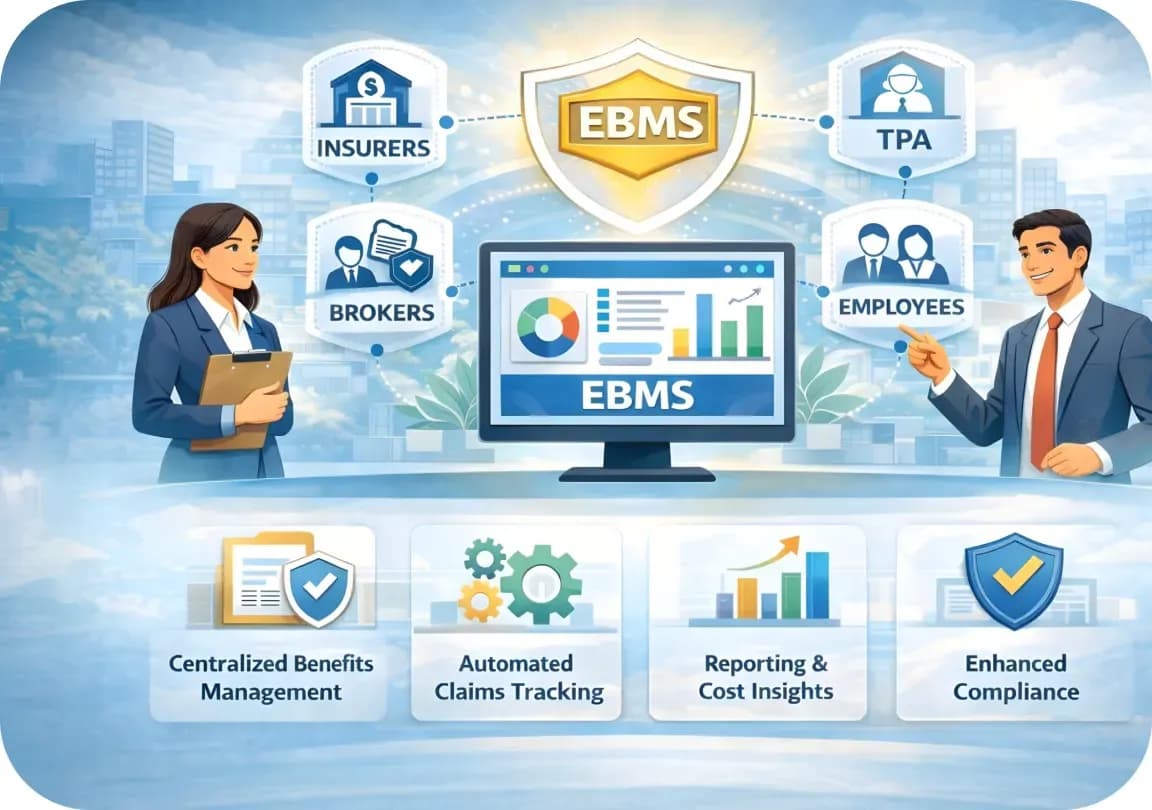
EBMS stands for Employee Benefits Management System. In simple terms, it is a centralized digital platform that helps organizations manage their entire employee benefits lifecycle from enrollment and policy documentation to claims tracking, reporting, and stakeholder coordination. For HR leaders and founders, EBMS acts as the operational backbone of the benefits ecosystem.
Understanding EBMS in the Context of Insurance
At its core, EBMS is not an insurance company and it does not underwrite risk. Instead, it functions as a technology and orchestration layer that connects employers, insurers, brokers, TPAs, payroll systems, and employees within a unified environment.
Traditionally, HR teams coordinate with multiple parties:
- Insurance carriers for policy issuance and renewals
- Brokers for negotiations and advisory
- TPAs for claims administration
- Employees for onboarding, queries, and documentation
An EBMS integrates these touchpoints into one structured system. Rather than chasing emails or reconciling fragmented data, HR teams get centralized visibility into policies, claims, enrollments, and performance metrics.
The system becomes a single source of truth for benefits operations.
Why Corporates Need an EBMS
As organizations scale beyond 50–100 employees, benefits administration becomes increasingly complex. Multiple plans, varying coverage types, dependent management, regulatory documentation, and renewals create operational strain.
An EBMS addresses this by providing:
- Centralized documentation and policy management
- Automated enrollment and onboarding workflows
- Real-time claims tracking and status visibility
For founders, this means reduced operational friction and better cost predictability. For HR leaders, it means moving from reactive firefighting to proactive management.
Without a structured system, even minor administrative lapses can lead to compliance issues, claim delays, or employee dissatisfaction. A digital management layer reduces these risks by standardizing processes and maintaining audit trails.
Key Components of an EBMS
While features may vary across platforms, most robust EBMS solutions include a combination of the following capabilities.
1. Enrollment and Policy Lifecycle Management
EBMS platforms digitize employee onboarding into benefit plans. Employees can select coverage, add dependents, upload documents, and receive confirmation within structured workflows. HR teams can approve, modify, or track these requests in real time.
Policy renewals are managed systematically, with historical data preserved for reference. This ensures version control and prevents miscommunication during renewal cycles.
2. Claims Visibility and Coordination
Although insurers or TPAs adjudicate claims, EBMS platforms provide tracking dashboards that allow HR teams and employees to monitor claim progress.
This creates transparency without transferring underwriting responsibility. Employers gain oversight without directly handling medical claim processing.
3. Analytics and Reporting
Benefits are one of the largest cost centers in HR budgets. An EBMS enables corporates to access actionable insights such as:
- Claims ratio trends
- Utilization patterns
- Department-wise or demographic-level usage
- Renewal risk indicators
These insights allow leadership teams to negotiate better, redesign plans strategically, or evaluate self-funded options with data-backed confidence.
EBMS vs. Insurance Company: Clearing the Confusion
One common misconception is that a benefits platform functions like an insurer. While an EBMS may appear central to the employee experience, it does not assume financial liability for claims.
An insurance company:
- Underwrites and prices risk
- Collects premiums
- Pays claims from pooled reserves
An EBMS:
- Provides digital infrastructure
- Coordinates workflows
- Enables reporting and transparency
Understanding this distinction is crucial for corporates evaluating partners. Risk-bearing and technology enablement are structurally different roles
Strategic Benefits for HR Leaders
HR functions are evolving from administrative roles to strategic workforce architects. Benefits are central to talent acquisition, retention, and employee satisfaction.
An EBMS supports this shift by:
- Enhancing employee experience through digital access
- Reducing manual workload and dependency on email-based processes
- Providing structured data for leadership reporting
Instead of responding to ad hoc claim queries or document requests, HR teams can focus on policy design, vendor evaluation, and employee engagement initiatives.
Operational Advantages for Founders and CXOs
From a founder’s perspective, benefits spending must align with financial discipline. Lack of transparency in claims performance can create renewal shocks or unexpected premium escalations.
An EBMS introduces governance by offering:
- Predictable reporting cycles
- Early warning signals for high utilization trends
- Clear documentation trails for audits
This operational clarity supports better budgeting and risk planning. It also strengthens decision-making when evaluating alternative insurers or benefit structures.
Compliance and Audit Readiness
In regulated markets, benefits documentation, policy records, and communication trails must be maintained accurately. Manual systems often fail during audits due to version confusion or missing documentation.
An EBMS centralizes compliance artifacts and preserves change history. When audits occur, documentation retrieval is streamlined and structured.
This reduces both legal exposure and reputational risk.
The Future of Benefits Management
The benefits ecosystem is becoming more interconnected. Payroll systems, HRMS platforms, insurers, wellness providers, and analytics tools must work together seamlessly. Fragmented systems slow down operations and increase errors.
EBMS platforms act as connective infrastructure. Rather than replacing insurers or brokers, they enhance interoperability across the stack. As data-driven decision-making becomes the norm, corporates will increasingly rely on integrated management systems rather than standalone processes.
Digital orchestration is no longer optional; it is becoming foundational.
Conclusion
EBMS, or Employee Benefits Management System, is a technology platform that centralizes and streamlines how organizations manage insurance and employee benefit programs. It does not replace insurers or assume financial risk, but it provides the infrastructure that enables transparency, automation, and data-driven control.
For HR leaders, it transforms benefits from an operational burden into a strategic capability. For founders and corporate decision-makers, it introduces cost visibility, compliance readiness, and governance discipline.
As benefits programs grow more complex, corporates that adopt structured management systems will gain greater control over both employee experience and financial outcomes. In the modern insurance ecosystem, clarity of roles and strength of infrastructure are what ultimately define long-term sustainability.
Latest Blogs
Be the first one to know about latest happenings in the Insurtech sector.
Use cases
Reach us


Address

4th Floor, plot no. 341, Industrial Area, Phase 9, Mohali, Punjab, India - 160062

5, Izabella House, 24-26 Regent Pl, Birmingham B1 3NJ, United Kingdom
Powered by


© Copyright 2026 www.benfit.care. All rights reserved.