


The modern benefits stack: How platforms differ from insurers, brokers, and TPAs
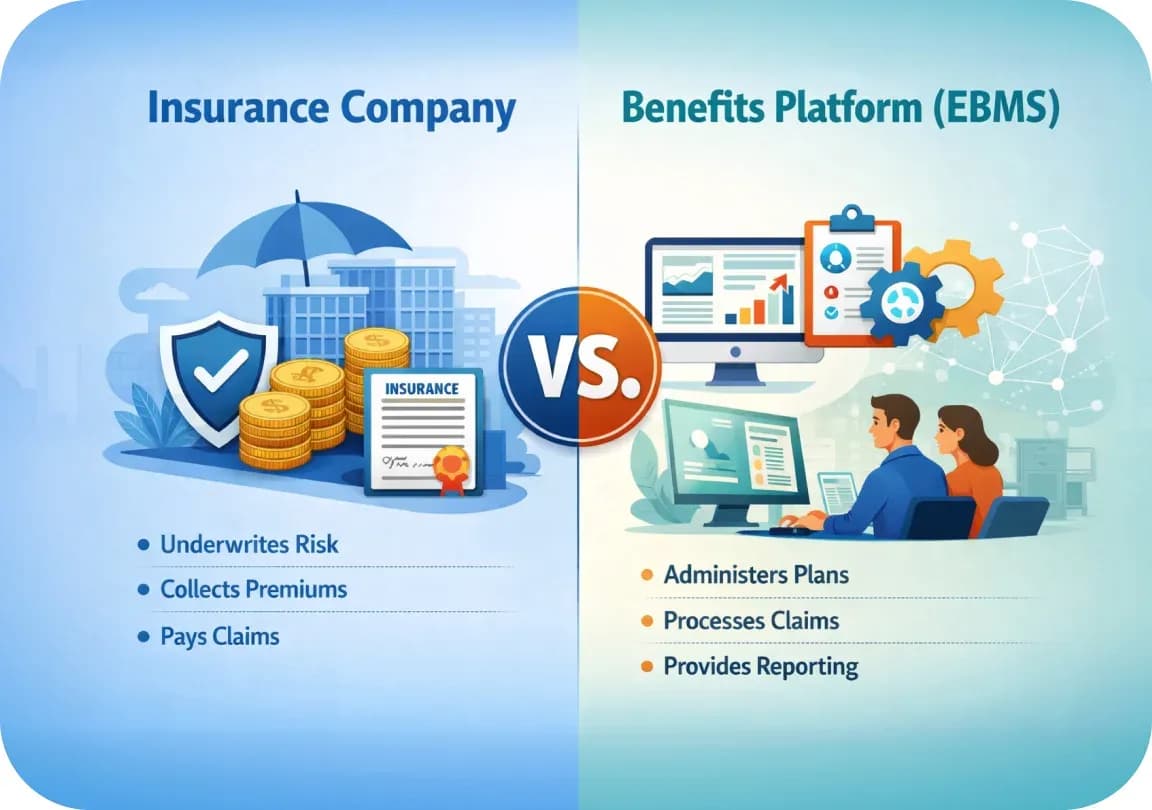
The employee benefits ecosystem is evolving into a layered, technology-driven stack. This article explains the structural differences between insurance companies, brokers, third-party administrators (TPAs), and modern benefits platforms—clarifying risk ownership, operational roles, and digital enablement for informed decision-making.
Introduction: Why the Lines Are Blurring
The employee benefits ecosystem has undergone a structural shift. What was once a straightforward relationship between employer, insurance carrier, and broker has evolved into a layered, technology-driven operating model. Today, digital dashboards manage enrollments, claims are tracked in real time, analytics provide plan performance insights, and compliance workflows are automated. In this environment, distinctions between insurers, brokers, third-party administrators (TPAs), and benefits platforms are increasingly misunderstood. When a platform provides end-to-end visibility, manages networks, and supports claims workflows, it can appear indistinguishable from an insurance company. However, the core differentiator in the modern benefits stack is not functionality it is financial responsibility. Understanding who carries risk, who advises, who administers, and who enables technology is essential for employers, distributors, and insurers making strategic decisions. At its core, the modern benefits stack separates risk ownership from operational and technological enablement.
What Is an Insurance Company?
An insurance company is fundamentally a risk-bearing institution. Its primary role is underwriting assessing risk, pricing policies, collecting premiums, and assuming financial responsibility for claims. Insurers pool risk across policyholders and maintain capital reserves to meet regulatory and solvency requirements. When an employer purchases a fully insured health plan, the insurer assumes the financial liability for covered claims. The employer pays a predictable premium, and the insurer absorbs the variability of healthcare costs. Product design, actuarial pricing, regulatory compliance, and capital management sit at the core of the insurer’s operating model. Even when insurers offer digital tools or customer portals, their primary mandate remains financial risk management.
What Is a Broker or Consultant?
A broker operates as an advisor and intermediary between employers and insurance carriers. Brokers do not assume underwriting risk, nor do they typically process claims directly. Instead, they evaluate carrier options, negotiate pricing and terms, structure benefit programs, and guide employers through renewal cycles and compliance considerations. Their value lies in market access, strategic advisory, and plan optimization. Compensation is generally commission-based or fee-based, depending on the structure of engagement. While some brokers offer expanded consulting capabilities, their function within the stack remains advisory and distribution-focused rather than operational or risk-bearing.
What Is a Third-Party Administrator (TPA)?
A third-party administrator plays an operational role, particularly in self-funded insurance arrangements. In a self-funded model, the employer retains the financial risk for claims, and the TPA manages the day-to-day administration of the plan. This typically includes claims adjudication, provider network coordination, compliance support, reporting, and member servicing. The TPA ensures that the plan operates efficiently and in accordance with regulatory requirements, but it does not usually underwrite or assume the financial liability for claims. The distinction is subtle but critical: a TPA administers risk on behalf of an employer; it does not absorb that risk itself.
What Is a Benefits Platform?
A benefits platform represents a more recent layer in the ecosystem one centered on technology infrastructure and orchestration. Unlike insurers, platforms do not underwrite risk. Unlike brokers, they do not primarily function as market intermediaries. And unlike traditional TPAs, their core value is not limited to administrative processing. Instead, benefits platforms act as connective infrastructure across the entire ecosystem. They integrate insurers, TPAs, brokers, payroll systems, HRMS platforms, and employers into a unified operating environment. They provide enrollment workflows, automation tools, analytics dashboards, data transparency, integration APIs, and performance tracking. Where insurers manage capital and risk, and TPAs manage administrative workflows, platforms manage information flow and system coordination.
In many cases, a platform may sit above insurers and TPAs, providing visibility and operational control without assuming underwriting liability. This is why platforms can sometimes be mistaken for insurers they appear central to the experience yet structurally they function as technology and orchestration layers.
A Side-by-Side View of the Modern Benefits Stack The distinction becomes clearer when roles are viewed comparatively:
- Insurance Company: Assumes financial risk, designs and prices policies, pays claims from pooled premiums.
- Broker/Consultant: Advises employers, negotiates with carriers, and structures benefit programs.
- TPA: Administers claims and plan operations, particularly in self-funded models, without underwriting risk.
- Benefits Platform: Provides technology infrastructure, integration, automation, analytics, and ecosystem coordination without assuming financial liability. Each entity plays a distinct role. Confusion arises when functionality overlaps but responsibility does not.
Why the Stack Is Shifting
The growing prominence of benefits platforms reflects broader industry trends. Employers are demanding cost transparency, customization, and data visibility. Self-funded arrangements are gaining adoption as organizations seek greater control over healthcare spend. Integration across payroll, HR systems, and compliance tools has become operationally essential. As benefits programs become more complex, the need for a unifying operating system has increased. Platforms are emerging to fill that gap not by replacing insurers or brokers, but by enabling interoperability across them. This shift creates strategic implications. Insurers must evaluate whether to build, partner with, or integrate into platform ecosystems. Brokers must adapt to technology-enabled advisory models. Employers must decide whether to prioritize risk transfer through fully insured plans or operational control through self-funded and platform-supported structures.
Conclusion: Clarifying the Structural Roles
In the modern benefits stack, roles are distinct even when experiences appear similar. Insurers carry financial risk. Brokers guide decisions and negotiate placement. TPAs administer plan operations. Benefits platforms orchestrate technology, data, and connectivity across the ecosystem. Understanding these structural differences is more than semantic clarity it determines risk exposure, cost predictability, operational efficiency, and strategic flexibility. As the benefits landscape becomes increasingly technology-driven, recognizing where each entity sits within the stack allows stakeholders to make more informed, deliberate decisions.
Latest Blogs
Be the first one to know about latest happenings in the Insurtech sector.
Use cases
Reach us


Address

4th Floor, plot no. 341, Industrial Area, Phase 9, Mohali, Punjab, India - 160062

5, Izabella House, 24-26 Regent Pl, Birmingham B1 3NJ, United Kingdom
Powered by


© Copyright 2026 www.benfit.care. All rights reserved.